


Attracting visitors to your website is only the first step towards business growth. The real challenge is turning those visitors into potential customers and eventually converting them into paying clients. Without a clear strategy, businesses may receive website traffic but struggle to generate enquiries, sales, or consistent leads.
A marketing funnel helps businesses guide potential customers through each stage of their buying journey, from discovering a brand to making a purchase. With the right combination of content marketing, search engine optimization (SEO), paid advertising, and conversion optimization, businesses can create a more effective path from website visits to sales.
Whether you run a startup, a small business, or an established company, understanding how to build a marketing funnel can help you make better use of your marketing budget and improve your conversion rates.
What Is a Marketing Funnel?
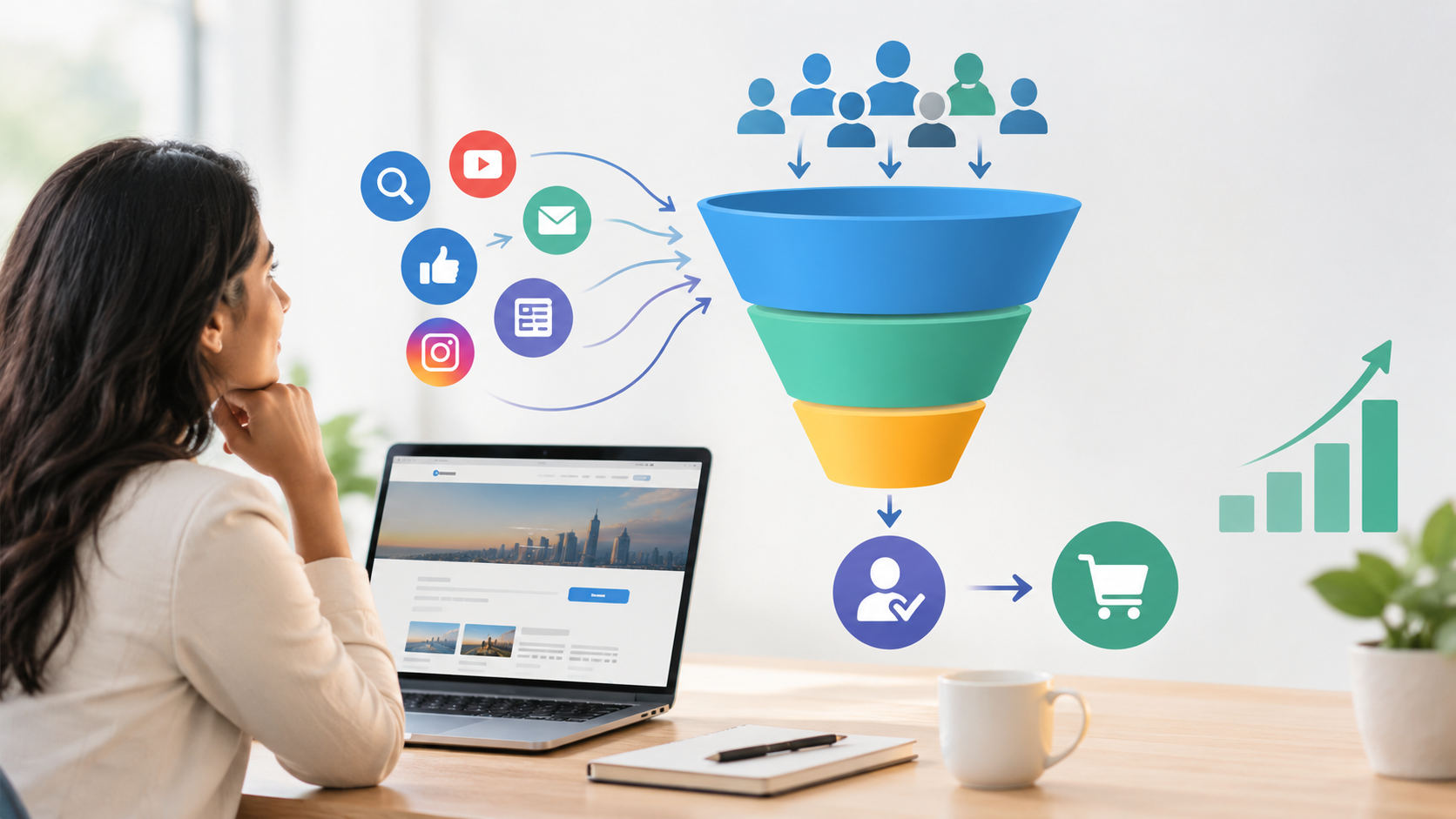
A marketing funnel is a structured process that guides potential customers from their first interaction with your brand to the final purchase. It helps businesses understand what customers need at different stages and deliver the right information to encourage them to take the next step.
A typical marketing funnel consists of three main stages:
- Awareness: Potential customers discover your business through search engines, social media, advertisements, or other channels.
- Consideration: Visitors explore your services, compare available options, read reviews, and evaluate whether your business meets their needs.
- Conversion: Interested prospects take action by requesting a quote, booking a consultation, contacting your sales team, or completing a purchase.
Some funnels also include retention and advocacy stages, which focus on encouraging repeat purchases, customer loyalty, and referrals.
Step 1: Attract the Right Website Visitors
An effective marketing funnel starts with attracting people who are genuinely interested in your products or services. Generating large amounts of traffic is not enough if those visitors are unlikely to become customers.
Start by identifying your target audience, their challenges, their location, and the solutions they are searching for. This information helps you choose the most relevant marketing channels.
Several strategies can help attract qualified visitors:
- Search engine optimization: Optimize your website for relevant search terms so potential customers can discover your business through organic search.
- Pay-per-click advertising: Use targeted campaigns to reach people actively searching for specific products or services.
- Social media marketing: Share useful content, showcase your expertise, and connect with your target audience.
- Content marketing: Publish blogs, guides, and resources that answer customer questions and address common problems.
For businesses targeting the UAE market, working with a reliable digital marketing agency in Dubai can help align these channels with local search behaviour, customer expectations, and business goals.
The key is to prioritize traffic quality over traffic quantity. Visitors who match your ideal customer profile are more likely to engage with your content and move further through the funnel.
Step 2: Create Landing Pages That Encourage Action
Once visitors arrive on your website, the next step is to give them a clear reason to stay and explore your services.
A landing page should immediately communicate what your business offers, who it helps, and why visitors should consider your solution. Avoid confusing layouts, unnecessary information, or competing calls to action that make it difficult for users to decide what to do next.
To improve landing page performance:
- Write a clear, benefit-focused headline.
- Explain how your product or service solves a specific problem.
- Highlight relevant features and customer benefits.
- Include testimonials, case studies, or other genuine trust signals.
- Add a prominent call to action, such as “Request a Quote” or “Book a Consultation.”
- Ensure the page loads quickly and works smoothly on mobile devices.
For example, a service-based business can create separate landing pages for individual services instead of directing every advertising campaign to its homepage. This helps visitors find information that matches their search intent and makes the next step easier.
Step 3: Use SEO to Capture High-Intent Searches
Search engine optimization plays an important role in attracting potential customers who are already looking for a solution.
A well-optimized website can reach users at different stages of the marketing funnel. Informational blog posts attract people researching a problem, while service pages can target users who are closer to making a purchase.
When choosing an SEO agency in Dubai, businesses should look for a strategic approach that includes keyword research, technical SEO, content optimization, internal linking, and performance measurement.
To strengthen your SEO funnel:
- Identify keywords based on customer needs and search intent.
- Create informative blog posts that answer relevant questions.
- Optimize service pages for commercial and transactional searches.
- Link related blog posts to the appropriate service pages.
- Improve website speed, mobile usability, and crawlability.
- Monitor organic traffic, keyword visibility, enquiries, and conversions.
SEO works best when it is connected to business outcomes. Instead of measuring success only through rankings or traffic, evaluate whether organic search is bringing qualified visitors who engage with your website and generate enquiries.
Step 4: Build Trust During the Consideration Stage
Visitors rarely make a purchasing decision immediately after discovering a business. They often compare providers, review available options, and look for evidence that a company can deliver what it promises.
Your marketing funnel should address these concerns before asking visitors to commit.
Useful trust-building content includes:
- Customer testimonials and verified reviews.
- Detailed service descriptions and frequently asked questions.
- Case studies with accurate results and supporting context.
- Comparison guides that explain the differences between available solutions.
- Educational blog posts that demonstrate industry knowledge.
- Clear information about your process, experience, and customer support.
For example, businesses comparing advertising and marketing agencies in Dubai may want to understand service offerings, campaign management processes, reporting practices, and how marketing performance is evaluated.
Providing this information helps prospective customers make informed decisions and gives them more confidence in contacting your business.
Step 5: Use Remarketing to Reconnect with Interested Visitors
Not every website visitor will convert during their first session. Some may leave to compare providers, discuss a decision internally, or return when they are ready to purchase.
Remarketing can help you reconnect with eligible visitors through relevant advertising, subject to applicable platform policies and consent requirements.
An effective remarketing strategy may include:
- Showing relevant advertisements to visitors who explored specific service pages.
- Promoting helpful guides to users who are still researching.
- Sharing suitable offers with prospects who have shown purchase intent.
- Excluding existing customers or recent converters when appropriate.
- Using frequency controls to avoid overwhelming your audience.
Your messaging should reflect the visitor’s stage in the funnel. Someone who has only read a blog post may need educational content, while someone who visited a pricing or contact page may be ready for a consultation.
Always ensure your remarketing campaigns comply with applicable privacy regulations and advertising platform requirements.
Step 6: Simplify the Conversion Process
Even when visitors are interested in your services, a complicated conversion process can prevent them from taking action.
Review the steps users must complete before becoming a lead or customer. If the process involves too many fields, unclear instructions, slow pages, or unnecessary steps, potential customers may abandon it.
Consider the following improvements:
- Keep enquiry forms short and relevant.
- Make contact details easy to find.
- Offer convenient contact options where appropriate.
- Clearly explain what happens after a form is submitted.
- Display transparent pricing or quote-request information when possible.
- Test different headlines, calls to action, and page layouts.
Track meaningful conversion events, including form submissions, phone enquiries, consultation bookings, purchases, and qualified leads. This helps you identify where visitors drop out of the funnel and which improvements are producing results.
Step 7: Measure Performance and Improve Your Funnel
A marketing funnel should be continuously monitored and refined. Tracking the right metrics helps you understand which channels attract visitors, which pages encourage engagement, and where potential customers leave before converting.
Important metrics include:
- Traffic sources: Identify how visitors arrive at your website.
- Landing page conversion rate: Measure the percentage of visitors who complete a desired action.
- Lead generation rate: Track how effectively your website turns visitors into enquiries.
- Cost per lead: Calculate how much you spend to generate a lead.
- Customer acquisition cost: Estimate the cost of acquiring a paying customer.
- Return on advertising spend: Evaluate revenue generated relative to advertising expenditure where revenue tracking is available.
Use tools such as Google Analytics 4, Google Search Console, and advertising platform reports to understand performance. Where possible, connect lead data with sales outcomes to distinguish between enquiries and genuinely valuable customers.
Regularly review the results, identify weak points, and test improvements. Small changes to a landing page, campaign audience, or follow-up process can reveal opportunities to improve overall performance.
Common Marketing Funnel Mistakes to Avoid
Even well-planned campaigns can underperform when important parts of the customer journey are overlooked.
Avoid these common mistakes:
Attracting irrelevant traffic: Targeting broad keywords or poorly defined audiences can generate visits without meaningful enquiries.
Using the same message for every audience: Different visitors have different needs. Match your content and advertising to their level of awareness and purchase intent.
Ignoring mobile users: Poor mobile experiences can make it difficult for visitors to browse services, complete forms, or contact your business.
Failing to build trust: Unsupported claims, unclear service information, and missing proof points can make potential customers hesitant.
Measuring traffic instead of business outcomes: High visitor numbers do not necessarily mean more sales. Track leads, qualified enquiries, and revenue wherever possible.
Neglecting follow-up: Responding promptly and providing relevant information can help prevent interested prospects from losing momentum.
Conclusion
Building a marketing funnel that converts website visitors into customers requires more than driving traffic. Businesses need a coordinated strategy that attracts relevant audiences, provides useful information, builds trust, simplifies conversions, and measures performance at every stage.
From SEO and content marketing to paid advertising and landing page optimization, each activity should support a clear business objective.
Fresh Media Production helps businesses approach digital marketing strategically by connecting online visibility with audience engagement and conversion-focused marketing. If you want to improve your website’s ability to generate qualified enquiries and support sustainable growth, explore the right marketing solutions for your business.
Frequently Asked Questions
1. What is the main purpose of a marketing funnel?
The main purpose of a marketing funnel is to guide potential customers from discovering a business to taking a desired action, such as requesting a quote, booking a consultation, or making a purchase.
2. How does SEO support a marketing funnel?
SEO attracts people searching for relevant information, products, or services. Informational content helps build awareness, while optimized service pages help potential customers evaluate options and take action.
3. How long does it take to see results from a marketing funnel?
The timeline depends on your industry, traffic sources, budget, competition, and conversion process. Paid campaigns may generate initial leads relatively quickly, while SEO and organic content typically require sustained effort.
4. Do small businesses need a marketing funnel?
Yes. A simple funnel can help small businesses organize their marketing activities, understand customer needs, follow up with potential customers, and use their budgets more effectively.
5. How can a digital marketing agency help improve conversions?
A digital marketing agency can review traffic sources, analyze customer journeys, optimize landing pages, improve SEO, manage advertising campaigns, and measure conversion performance to identify opportunities for improvement.